Über den Erwerb und Verbleib der Mumien und Schädel, gesammelt von Franz Julius Ferdinand Meyen

Authors

  • Sven Schumann Lehrstuhl für Makroskopische Anatomie, Medizinische Universität Lausitz – Carl Thiem, Cottbus
  • Anna-Maria Begerock Instituto de Estudios Científicos en Momias (IECIM), Madrid
  • Mercedes González Instituto de Estudios Científicos en Momias (IECIM), Madrid
  • Evelyn Heuckendorf Institut für Integrative Neuroanatomie, Fächerverbund Anatomie, Charité – Universitätsmedizin Berlin
  • Roman Sokiranski Abteilung für Anatomie und Zellbiologie, Medizinische Universität Varna
  • Barbara Teßmann Berliner Gesellschaft für Anthropologie, Ethnologie und Urgeschichte (BGAEU), Berlin
  • Andreas Winkelmann Institut für Anatomie, Medizinische Hochschule Brandenburg – Theodor Fontane, Neuruppin

DOI:

https://doi.org/10.18443/399

Keywords:

Mumie, Peru, Human Remains, Schädel, Anthropologie

Abstract

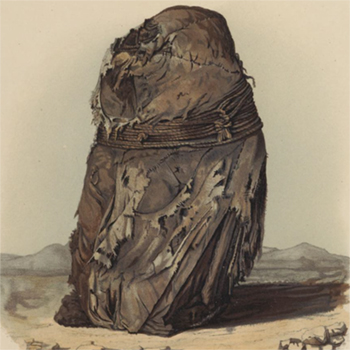
The Prussian physician, botanist, and explorer Franz Julius Ferdinand Meyen served as a ship's doctor in South America from 1830 to 1832, on the recommendation of Alexander von Humboldt. Partly following Humboldt's footsteps, he acquired six "Peruvian" skulls and two "Peruvian" mummies during this voyage. The two mummies are now part of the collection of the Fächerverbund Anatomie, Charité, Berlin. While one of the mummies has been skeletonized, the other still retains skin and soft tissue. However, since no grave goods or parts of the burial bundle have survived for any of the mummies, their cultural classification remains uncertain. Two of the six skulls acquired by Meyen could probably be identified. They are now cared for in the depot of the National Museums in Berlin. The handling of the mummies and skulls from pre-Columbian South American cultures is a good example of research and collection practices in the 19th century.
Author Biographies

  • Sven Schumann, Lehrstuhl für Makroskopische Anatomie, Medizinische Universität Lausitz – Carl Thiem, Cottbus

    Studium der Humanmedizin und Medical Education in Essen und Heidelberg. Nach abgeschlossener Facharztausbildung für Anatomie in Magdeburg arbeitete er als Junior- und Gastprofessor in Mainz und Neuruppin. Seit 2025 ist er Lehrstuhlinhaber für Makroskopische Anatomie an der Medizinischen Universität Lausitz. Seine Forschungsschwerpunkte sind anatomische Variationen und Osteoanthropologie.


  • Anna-Maria Begerock, Instituto de Estudios Científicos en Momias (IECIM), Madrid

    Researcher for decontextualized South American mummies and non-European human remains in German collections for the IECIM (Institute for the Scientific Investigation of Mummies, Madrid). She also focuses on the role of ancestors for the living. Recent publications include Trauma of Bone and Soft Tissues in South American Mummies: New Cases Provide Insight into Violence and Lethal Outcome (2022) and The Ethics of Casts Plaster Casts of Skulls, Faces and Bodies from Colonial Australia (2024).

  • Mercedes González, Instituto de Estudios Científicos en Momias (IECIM), Madrid

    President and Founder of the IECIM, Institute for the Scientific Study of Mummies, in Madrid. She is a Senior Technician in Pathological Anatomy and Autopsy Techniques, specialized in Paleopathology and Physical Anthropology (CETYS – Universidad Francisco de Vitoria, Madrid). Dedicated to the scientific research of mummified human remains, she participated in numerous projects and conferences.


  • Evelyn Heuckendorf, Institut für Integrative Neuroanatomie, Fächerverbund Anatomie, Charité – Universitätsmedizin Berlin

    Evelyn Heuckendorf ist Ingenieurin für medizinisch-morphologische Präparationstechnik. Seit 1981 arbeitet sie am Institut für Anatomie / Fächerverbund Anatomie der Charité – Universitätsmedizin Berlin. Sie ist hier als Präparatorin tätig und ist Sammlungsbeauftragte.

  • Roman Sokiranski, Abteilung für Anatomie und Zellbiologie, Medizinische Universität Varna

    Studium der Humanmedizin an der FU Berlin, Promotion und Facharztweiterbildung an der FU Berlin und der Universität Tübingen, Habilitation an der Universität Ulm, Erteilung der Lehrbefugnis für das Fach Radiologie. Anschließend Leitung der Abteilung für Radiologie am Klinikum Traunstein – Akademisches Lehrkrankenhaus der LMU München, Gastprofessur an der Tongji Universität in Wuhan, China. Leitung des Zentrums für Radiologie im MVZ Heidelberg/Erbach. Aktuell Gastprofessur an der Medizinischen Universität in Varna, Bulgarien.

  • Barbara Teßmann, Berliner Gesellschaft für Anthropologie, Ethnologie und Urgeschichte (BGAEU), Berlin

    Studium der Ur- und Frühgeschichte, Anthropologie, Paläontologie und Vorderasiatische Altertumskunde in Berlin (Freie Universität und Humboldt-Universität). Von 1996 bis 2010 hat sie als Archäologin gearbeitet und seit 2010 als freiberufliche Anthropologin. Von 2017 bis 2025 war sie am Museum für Vor- und Frühgeschichte Berlin als Anthropologin in mehreren Projekten zur Provenienzforschung an kolonialzeitlichen Beständen angestellt.


  • Andreas Winkelmann, Institut für Anatomie, Medizinische Hochschule Brandenburg – Theodor Fontane, Neuruppin

    Studium der Medizin und Medical Anthropology. Nach klinischen und anatomischen Tätigkeiten ist er seit 2015 Professor für Anatomie der Medizinischen Hochschule Brandenburg in Neuruppin. Seine wissenschaftlichen Schwerpunkte sind die Geschichte und Ethik der Anatomie sowie Provenienzforschung, insbesondere an kolonialen Sammlungen.

Published

2026-06-19

Issue

Section

Articles

How to Cite

Schumann, S., Begerock, A.-M., González, M., Heuckendorf, E., Sokiranski, R., Teßmann, B., & Winkelmann, A. (2026). Über den Erwerb und Verbleib der Mumien und Schädel, gesammelt von Franz Julius Ferdinand Meyen. HiN - Alexander Von Humboldt in the Net. International Review for Humboldt Studies, 27(51), 139–154. https://doi.org/10.18443/399