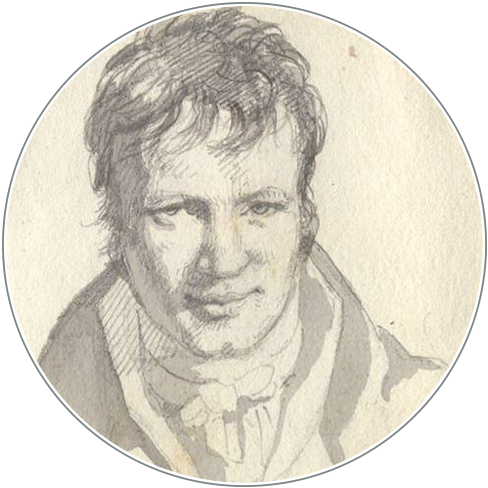
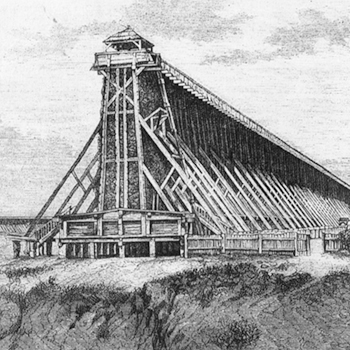
Based on Alexander von Humboldt’s positive forecast of 1794, Alexander von Mielęcki reached by drill exploitable brine in 1806. Key figures in the construction of a saltworks in Ciechocinek included the investor Leon Konstanty Wolicki, Professor Johann Jacob Graff, and Finance Minister Prince Franciszek Ksawery Drucki-Lubecki. Their contributions are described in this paper. Construction began in 1824. During construction, errors occurred, which Carl von Laroche, Director of the Prussian Mining Authority, meticulously documented in a report in 1829. The saltworks, still under construction, was destroyed by Russian troops in 1831. Reconstruction took place in accordance with the proposals of Alexander von Humboldt and Carl von Laroche. The saltworks started operations in 1832.
DOI :
https://doi.org/10.18443/398Mots-clés :
Johann Jacob Graff, Konstanty Leon Wolicki, Carl Georg von Laroche, Slonsk an der Weichsel, Ciechocinek, Solevorkommen, 1789, Saline, SalzwerkRésumé
Auf der Basis der positiven Prognose Alexander von Humboldts aus dem Jahr 1794 erbohrte Alexander von Mielęcki im Jahr 1806 förderwürdige Sole. Wichtige Persönlichkeiten bei der Errichtung eines Salzwerkes in Ciechocinek waren der Investor Leon Konstanty Wolicki, der Professor Johann Jacob Graff sowie der Finanzminister Fürst Franciszek Ksawery Drucki-Lubecki. Deren Leistungen werden beschrieben. 1824 begannen die Arbeiten. Während des Baus kam es zu Fehlern, die der Direktor des Preußischen Oberbergamtes, Carl von Laroche, in einem Bericht im Jahr 1829 akribisch darlegte. Das im Bau befindliche Salzwerk wurde 1831 durch russische Truppen zerstört. Der Wiederaufbau erfolgte unter Beachtung der Vorschläge Alexander von Humboldts und Carl von Laroches. 1832 ging das Salzwerk in Betrieb.
Téléchargements
Publiée
Numéro
Rubrique
Licence
Merci de créditer les auteurs lors de toute citation : Dagmar Hülsenberg, Józef Tomasz Juros (2026)

Ce travail est disponible sous licence Creative Commons Attribution - Pas d’Utilisation Commerciale 4.0 International.
Les droits des articles envoyés restent la propriété de leurs auteurs et sont publiées sous la licence Creative Commons-Lizenz (CC BY-NC 4.0). Tous les auteurs publiant dans le HiN doivent accepter ce modèle de licence.
Les auteurs doivent eux-mêmes s’occuper de l’obtention des droits d’auteur pour les images utilisées.
Les divers éléments de la mise en page et du design de la revue sont protégés et ne peuvent être récupérés et réutilisés dans d’autres publications sans autorisation préalable de la part de HiN.